Marketing Analytics Has a Reputation Problem
Guiding principles to ensure marketing analytics has credibility within your organization.
Joe Fusaro
Founder, Datachef
A recent thread on Reddit caught my eye. The original post reads:
Anyone else find marketing analytics to be kind of a joke? I feel like I spend all day justifying bad marketing spend for managers. ... The work is just extremely unfulfilling and I feel like people are way more concerned with making something look like it performed good than actually doing great marketing. I take pride in my work and being truthful and this job makes me feel like I cover up for a lot of marketing incompetence instead of actually driving better results.
The thread currently has 141 upvotes and 78 comments, mostly in agreement with the original sentiment.
My take is that a good marketing analytics practice is
- devoid of vanity metrics (e.g. pageviews, email open rates)
- built upon data models that are explainable and defensible
- delivered by analysts who are impartial
The following are some principles that I have followed in my past life as a marketing analyst.
Table of Contents
- 1. Distinction between Upper and Lower Funnel Campaigns
- 2. Lower Funnel Tactics Should be Tied to Pipeline & Revenue
- 3. Attribution Models Must Be Explainable and Defensible
- 4. Monitor Data Governance Impacting Your Models
- 5. Set Expectations on What is Realistic
- What did I miss?
1. Distinction between Upper and Lower Funnel Campaigns
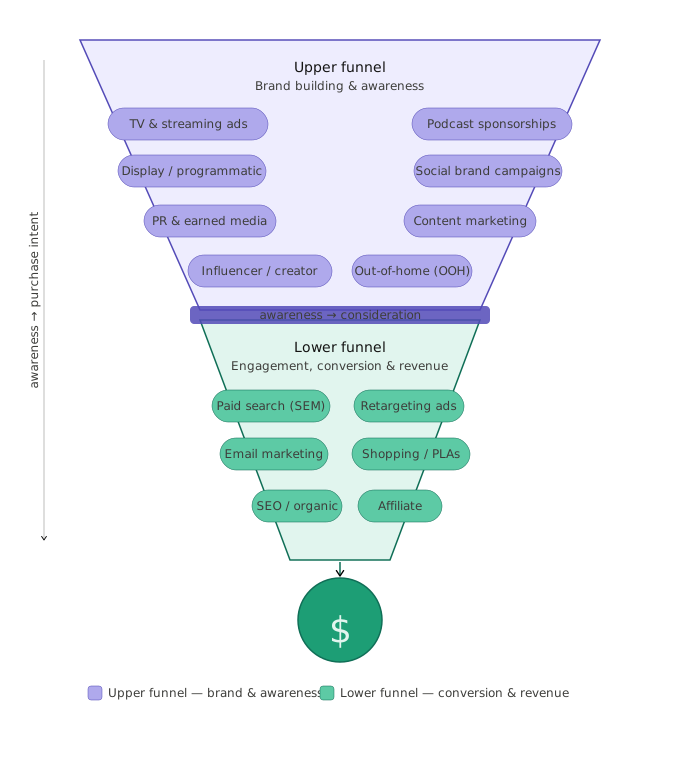
Upper funnel campaigns are intended to grow the brand. There may not be a direct response component with this sort of thing, and it cannot be measured easily, outside of periodic brand recall measurement over a sufficient time horizon. It has to be understood that upper funnel campaigns may not be directly attributed to conversion or revenue, and must be measured through a different lens.
Lower funnel marketing tactics are intended to convert passive interest to active interest and, ultimately, revenue.
Don't include upper funnel campaigns in your lower funnel analysis, and vice versa.
2. Lower Funnel Tactics Should be Tied to Pipeline & Revenue
Demand generation campaigns are meant to move buyers closer to a purchase.
If you are in B2B marketing, this might be converting readers of a blog to request a consultation call or book a demo. In B2C, this might be adding items to a shopping cart. There can also be retention or re-order metrics: in B2B, did a customer renew (or grow!) their contract? In B2C, did a customer re-order?
As the user beneenio points out:
Tie everything to a financial outcome the CFO cares about. If you can't draw a line from the metric to revenue, margin, or customer lifetime value, the metric is decorative.
3. Attribution Models Must Be Explainable and Defensible
I've encountered many marketing teams that have "black box" multi-touch attribution models that no one on their team actually understands. This is a problem; if you cannot explain how your attribution model works in a few sentences, how can anyone trust your analysis and recommendations?
In practice, there must be a time-based component to attribution.
You must know when a prospect responded to your campaign in relation to when the conversion to pipeline or revenue occurred.
And, your data model must validate that this response occurred before this conversion to pipeline or revenue within a defensible window of time. Otherwise you are giving credit to things that did not contribute to the buyers' decision to engage/purchase/renew/etc.
Depending on your business (B2B vs. B2C) and the duration of a typical sales cycle, there should be a "time boxed" component to your model. Meaning, it may not make sense to consider a campaign response four years prior if your typical sales cycle is 90 days.
4. Monitor Data Governance Impacting Your Models
Your models and analysis are only as good as the underlying data. And with most marketing data - especially in B2B, which is largely derived from user-managed CRM data - a lapse in data governance can result in unhappy stakeholders. You may, unfairly, be blamed for this, so it is in your best interest to keep an eye out for data issues that could impact your models.
For example, in Salesforce, Leads and Contacts are two separate objects (tables) where you store information about people.
Without good Lead hygiene, you end up with Lead records that never get "attached" to the right Account, i.e. they are never converted to a Contact and linked to that Account.
The impact on B2B marketing attribution: campaign responses tied to those Lead records won't make their way into your attribution model.
Said another way: A campaign may not get attribution "credit" for pipeline or revenue.
As a marketing analyst, you may have limited or no ability to resolve these issues at the source. However, I contend that you're at the very least responsible for highlighting them and being able to explain how they impact measurement.
As I've described in RACI for Salesforce Data Governance, data governance is a behemoth, and should be broken down into smaller manageable chunks, with different stakeholders accountable and responsible for monitoring and resolving data issues like this one.
5. Set Expectations on What is Realistic
We might strive for perfection, but we have to be realistic. We will never get to 100% accuracy because not everything can be tracked.
For instance, not all web activity can be associated directly to a person or company.
Cookies get cleared, and your buyers might use VPNs or cookie-blocking software.
You can't track word-of-mouth referrals at scale.
Here, expectation setting with stakeholders is crucial.
Even with a sufficient volume of data (of course this will differ based on your niche and industry), the output of marketing analytics should be taken with a grain of salt and treated as directional guidance.
What did I miss?
Have something to add to the above? Disagree with any or all of it?
I would love to hear from you! Send us a message at hello@datachef.com.
Want to build a solid marketing analytics foundation?
Watch a demo to see use cases or try Datachef free for 30 days.